
Seasons
Where to go, and when
There is no bad month to visit Sri Lanka. There are only months that decide which half of it you should be on.
The most consequential thing to understand about this island has nothing to do with sights or hotels or how long you have. It is that two separate monsoon systems arrive at opposite ends of the country at opposite times of year, and that a fortnight planned without knowing this can put you on a wet beach for the whole of it.
Get it right and Sri Lanka becomes something unusual: a destination that is in season somewhere in almost every month of the calendar.
The mechanism
The south-west monsoon runs from roughly May to September and brings rain to the south and west coasts and the western slopes of the hill country. The north-east monsoon runs from roughly October to January and brings rain to the east and the north.
Between them sit two inter-monsoon periods. The first, around March and April, is generally benign. The second, in October and November, is the one that catches people out — it brings rain to much of the island at once and is the only genuinely awkward window in the year.
There is almost always somewhere in season. It is a routing problem, not a calendar problem.
December to March: the south and west
The high season, and deservedly so. Galle, Mirissa, Weligama, Tangalle and the whole south-west coast are at their driest, the sea is calm enough for whale watching out of Mirissa, and Colombo is pleasant rather than punishing.
The Cultural Triangle works throughout, the hill country is clear in the mornings, and Yala is open, with the driest months still to come. If you are coming from Europe, North America or Australia over the winter holidays, this is the obvious window and everyone else knows it. Book early and expect high-season prices.
January to April: the interior
Slightly different from the coastal window and worth separating out. Sigiriya, Polonnaruwa, Anuradhapura, Kandy and Nuwara Eliya see the least rain in these months, with cool clear mornings that make climbing and walking a pleasure rather than a trial.
The Adam’s Peak pilgrimage season runs from the December full moon to Vesak in May, which is the only period the route is properly set up for climbers. April brings the Sinhala and Tamil New Year, when the country slows down for several days — worth knowing if you are trying to move around during it.
May to September: the east and the north
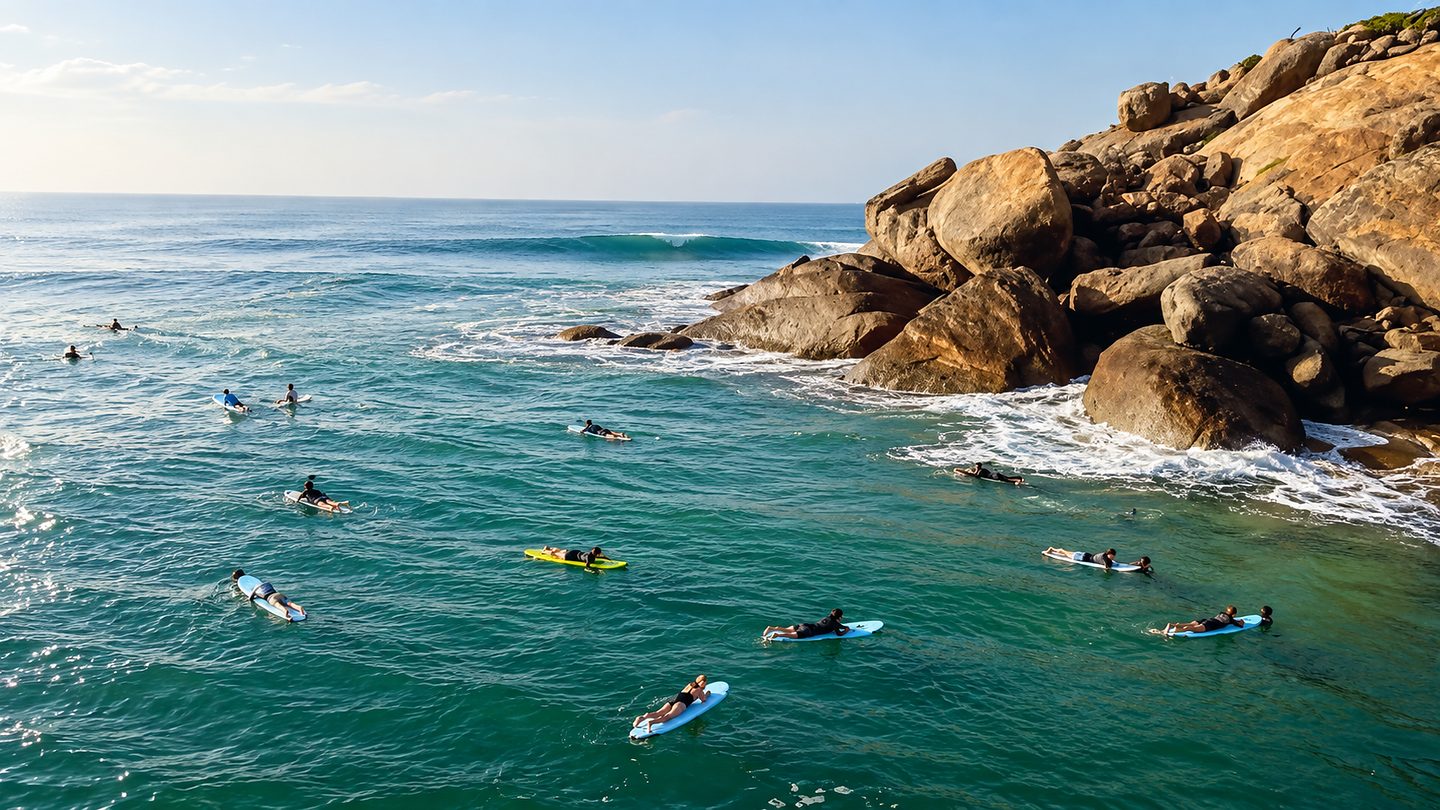
The inversion. As the south-west turns wet, the east coast comes into its own. Arugam Bay has its surf season, Trincomalee and Nilaveli are dry and swimmable, and the diving off Pigeon Island is at its best.
The north runs a similar calendar. Jaffna is dry for most of the year and wet under the north-east monsoon from October, which makes the summer months a strong window for the peninsula and the islands around it — and considerably quieter than the south is in its own season.
This is also when the Minneriya elephant gathering happens, roughly July to September, and when Kandy holds the Esala Perahera. For a European or Australian summer holiday, the east coast route is the right answer and almost nobody takes it.
October and November: the hard window
I would not tell you it is impossible, because it is not. But it is the one period where both coasts can be wet at the same time, and where a fixed itinerary becomes a liability.
If these are your dates, weight the trip toward the Cultural Triangle, which holds up better than either coast, expect afternoon downpours rather than all-day rain, and keep the plan loose enough to move. Flights and hotels are at their cheapest, and the island is at its greenest and emptiest. It is a real trade, not simply a bad month.
October and November are the cheapest, the greenest and the emptiest. They are also the wettest.
Month by month, at a glance
| Month | Where it is dry | Notes |
|---|---|---|
| January | South and west | Peak dry season. Galle, Mirissa, Tangalle. Interior clear. |
| February | South and west | The same window, quieter and cheaper than January. |
| March | South, west, interior | Still dry. First inter-monsoon begins, usually benign. |
| April | Interior | Cultural Triangle and hill country at their best. Sinhala and Tamil New Year mid-month. |
| May | East begins | South-west monsoon arrives. Arugam Bay opens up. |
| June | East and north | Trincomalee and Nilaveli dry. Jaffna good. |
| July | East and north | Surf season at Arugam Bay. Minneriya gathering begins. Esala Perahera in Kandy. |
| August | East and north | The strongest month for the east coast and the elephant gathering. |
| September | East, fading | East still dry but the season is ending. |
| October | Interior only | Second inter-monsoon. Both coasts can be wet. Keep plans loose. |
| November | Interior only | The hardest window. Cultural Triangle holds up best. |
| December | South and west | North-east monsoon in the east, south-west dries out. High season opens. |
The mistake to avoid
Combining Mirissa and Arugam Bay in one trip. They are the two best-known beach destinations in the country and they are in season at opposite times of year, so an itinerary containing both will always have you somewhere wet.
The same logic applies less dramatically elsewhere. Trincomalee in January is a long drive to a wet beach. Galle in July is a long drive to a different wet beach. The interior is the exception that holds most of the year, which is why almost every good route runs through it.
How to actually decide
Start with your dates, not your destinations. Work out which coast is dry when you can travel, build the trip around that coast, and use the Cultural Triangle and the hill country as the middle section regardless. That single reordering — season first, sights second — is the difference between the fortnight you imagined and the one you get.
It is also why the island rewards a second visit more than most. Come in January and you see one country. Come in July and you see the other one.
Month by month: January–March · April · May · June · July · August · September · October · November · December
Questions
When is the best time to visit Sri Lanka?
It depends which coast you want. December to March is the dry season on the south and west — Galle, Mirissa, Weligama, Tangalle — and the best window for the interior runs January to April. May to September inverts it: the east and north come into their own while the south-west turns wet. There is no bad month, only months that decide which half of the island you should be on.
Why does Sri Lanka have two monsoons?
Two separate systems arrive at opposite ends of the country at opposite times. The south-west monsoon runs roughly May to September and brings rain to the south and west coasts and the western hill country. The north-east monsoon runs roughly October to January and brings rain to the east and north. Between them sit two inter-monsoon periods.
What is the worst time to visit Sri Lanka?
October and November. It is the second inter-monsoon and the one period where both coasts can be wet at the same time. It is not impossible, but a fixed itinerary becomes a liability. Weight the trip toward the Cultural Triangle, which holds up better than either coast, and expect afternoon downpours rather than all-day rain.
Can you visit Mirissa and Arugam Bay on the same trip?
Not well. They are the two best-known beach destinations in the country and they are in season at opposite times of year, so an itinerary containing both will always have one of them in the wrong season. Pick the coast that matches your dates and build around it.
When is the best time for whale watching and the elephant gathering?
Whale watching out of Mirissa runs with the southern dry season, roughly December to April, when the sea is calm enough. The Minneriya elephant gathering runs roughly July to September, which is the eastern season. The two are half a year apart, which is another reason the island rewards a second visit.
Which month is best for the hill country and the Cultural Triangle?
January to April. Sigiriya, Polonnaruwa, Anuradhapura, Kandy and Nuwara Eliya see the least rain then, with cool clear mornings. The Adam's Peak pilgrimage season runs December to around mid-April, the only period the route is properly set up for climbers. The interior also holds up better than either coast during the October and November inter-monsoon.
Plan around it
Photography: Sebastian Latorre (The Sri Lankan coast from the air) · Sajeevan Balachandran (The Jaffna coast at dusk) · Robin Grevers (Nine Arch Bridge, Ella). Unsplash Licence.

Leave a comment