
Architecture
The house Sangakkara bought without seeing inside
They had walked past it for years. When Kumar and Yehali Sangakkara finally bought the house in 2008, they still had not been inside.
What they found when the door opened was not encouraging. The building was a hundred and twenty years old, Dutch in origin, wedged into a terrace of heritage-listed neighbours a few streets from the Galle lighthouse. It had the address and the bones. It did not have much else. “It was a complete wreck on the inside,” Sangakkara told the ABC Australia programme Culture by Design, which filmed inside the finished house for a series that went to air in August.
Plenty of houses inside the fort have been bought in that condition over the last thirty years. Rather fewer have been restored by the family who intend to keep them.
Who he is, for anyone who does not follow cricket
Kumar Sangakkara is the most accomplished batsman Sri Lanka has produced, and by most measures one of the finest the game has known. He kept wicket and batted at number three, which is roughly the equivalent of playing goalkeeper and centre-forward in the same match, and he did it for fifteen years. He is one of a very small group of players to have passed twelve thousand runs in Test cricket. He captained the country. He retired in 2015.
None of which is the reason Sri Lankans speak about him the way they do.
In 2011 he was invited to give the MCC Spirit of Cricket Cowdrey Lecture at Lord's, the sport's most prestigious address, and used it to talk about his country rather than himself — the civil war, the 2004 tsunami, the 2009 attack on the Sri Lankan team bus in Lahore, which he survived, and the failures of the people running cricket at home. It is still regarded as the best lecture the series has produced, and he delivered it while still playing, which took a particular kind of nerve.
Since retiring he has been president of the MCC, the first non-British person to hold the office in the club's history, and has coached in the Indian Premier League. He is, in other words, someone who could live anywhere. He chose a wreck of a house inside a fort in the town where he played some of his best cricket.
What owning a house in the fort actually means
Galle Fort is a working town of roughly a thousand residents living inside Dutch ramparts, and it carries UNESCO World Heritage listing. That listing is not decorative. It governs what an owner may do to a facade, a roofline, a window opening. The houses are built of coral and lime, materials that behave nothing like cement, and the tradesmen who understand them are not numerous.
The practical consequence is that restoration inside the walls runs slower and costs more than building new anywhere else on the coast. Sources differ on how long the Sangakkaras' project took — the figure has been reported in ways that do not agree — but nobody describes it as quick. Sangakkara's own account is of patience and frustration in roughly equal measure.
The people who did the work
The couple brought in the architects Jeevan D'Souza and Murad Ismail, and the designer Annika Fernando, whose name will be familiar to anyone who has spent time in Colombo's design scene. The brief, as far as it can be read from the finished house, was not to strip the building back to a museum piece or to gut it into something contemporary. It was to keep the argument between the two going.
So the coral walls are still there and still visible. Weathered surfaces have been left weathered. The house has four bedrooms and three courtyard gardens, which is the traditional Galle answer to heat and light — you do not air-condition a coral house into submission, you open it up and let it breathe through the middle. On the roof there is a swimming pool, which is not traditional at all, looking out toward the lighthouse and the Indian Ocean beyond it.
Why this one matters
The fort's restoration story over the past three decades has largely been written by outsiders. European buyers, hotel groups, expatriates with an eye for a courtyard. That investment saved a great many buildings that would otherwise have fallen down, and the fort would look very different without it.
But it produced a particular kind of place — beautifully kept, and increasingly owned by people who are not from here. A Sri Lankan family buying a wreck inside the walls and spending years putting it right, with Sri Lankan architects and a Sri Lankan designer, is a different proposition. Sangakkara has spoken about the house as a piece of the country's history that he hopes never to have to sell.
That is the part worth noticing. Not the rooftop pool.
One thing to be clear about
It is a private family home. It is not a hotel, it is not open to visitors, and it is not on any tour. The programme was filmed with the family's cooperation; that is not an invitation. If you are in the fort, admire the facades from the street like everyone else and leave the doorbell alone.
Where to see the same architecture
The good news is that the fort makes its case from the outside. The ochre walls, the tall shuttered windows, the coral rubble showing through failing plaster, the bougainvillea doing the work no gardener planned — all of it is visible on a slow walk. The Old Gate carries the Dutch East India Company arms and the date 1669. The ramparts take about an hour at an unhurried pace and are best done in the last hour of light.
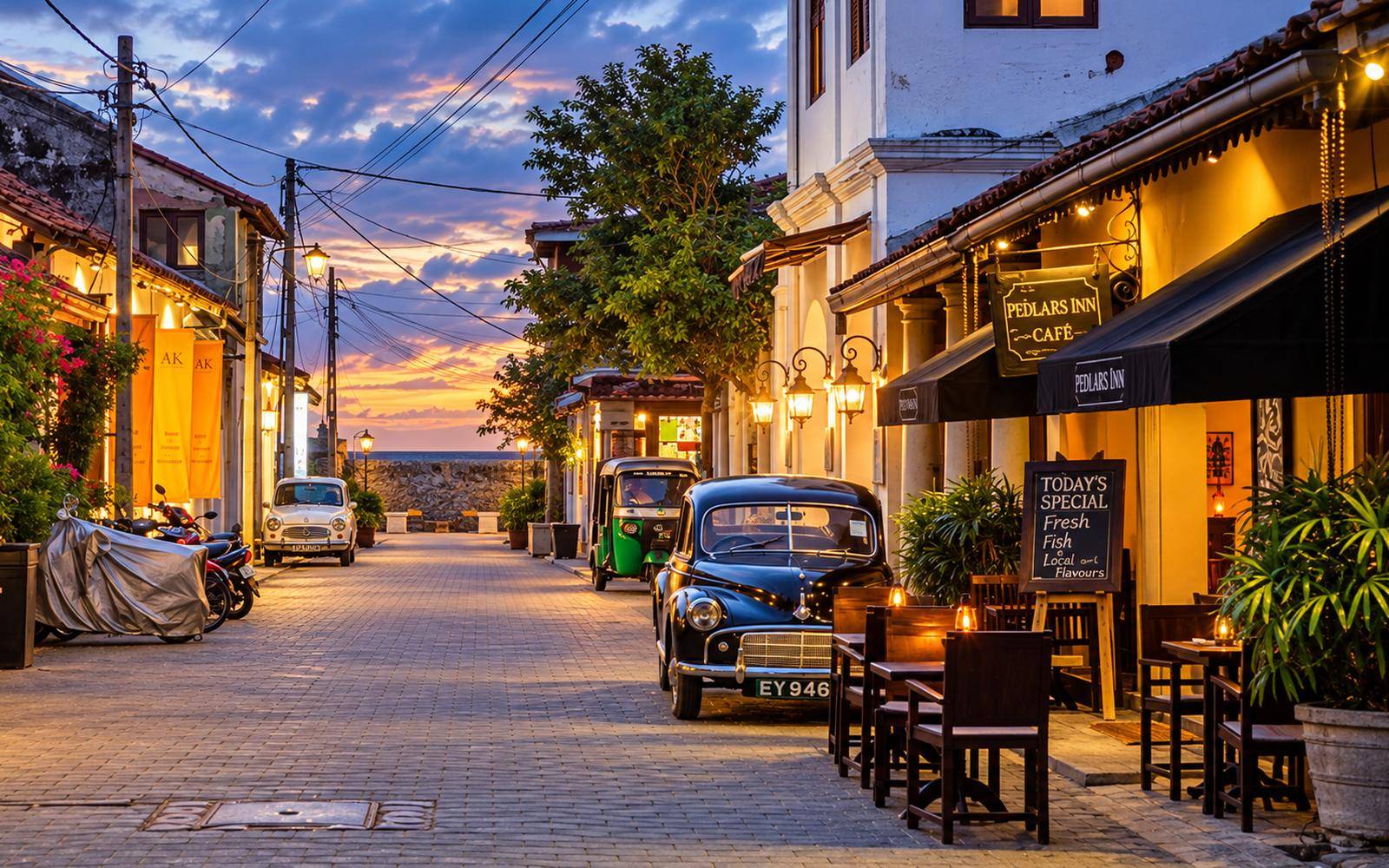
For the interiors, several restored fort houses do take guests, including a number of the stays we list in Galle. Amangalla occupies a building from the 1680s. The Fort Printers and Fort Bazaar are both merchant townhouses brought back in much the same spirit as the Sangakkaras' house, and you can sleep in them.
And if you want to understand why any of this looks the way it does, read Geoffrey Bawa first. Almost every good decision made inside these walls in the last fifty years traces back to him somehow.
Reporting on the restoration and the quotation above are drawn from ABC Australia's Culture by Design, series two, first broadcast 23 August 2026. Photography here is our own; the house interiors appear in the ABC programme.
Plan around it

Leave a comment