
Culture
Ten nights of fire in Kandy
For ten nights every year, a small hill town puts on one of the great religious processions on earth, and most visitors miss it by a week.
The Esala Perahera exists because of a tooth. The relic held in the Temple of the Tooth in Kandy is believed to be the Buddha's, brought to the island in the fourth century, and possession of it has historically conferred the right to rule. The procession is the relic's casket being taken through the town, and everything else — the elephants, the fire, the dancers, the whip crackers — is escort.
It builds. The first nights are relatively small. Each successive night the procession grows longer and more elaborate, until the final nights, when a hundred or so elephants and thousands of performers move through the streets for hours.
When it falls, and why you cannot just look it up
The Perahera runs in the month of Esala, which lands in July or August, and it concludes on the Nikini full moon. Because it follows the lunar calendar the dates shift each year, and they are set and announced by the temple rather than fixed in advance.
What this means practically: do not plan a trip around dates you found in an old article. Check the current year's schedule before booking anything, and if the Perahera is the reason you are coming, book accommodation months rather than weeks ahead. Kandy fills completely.
The dates move every year with the moon. Check the current schedule before you book anything.
What actually passes
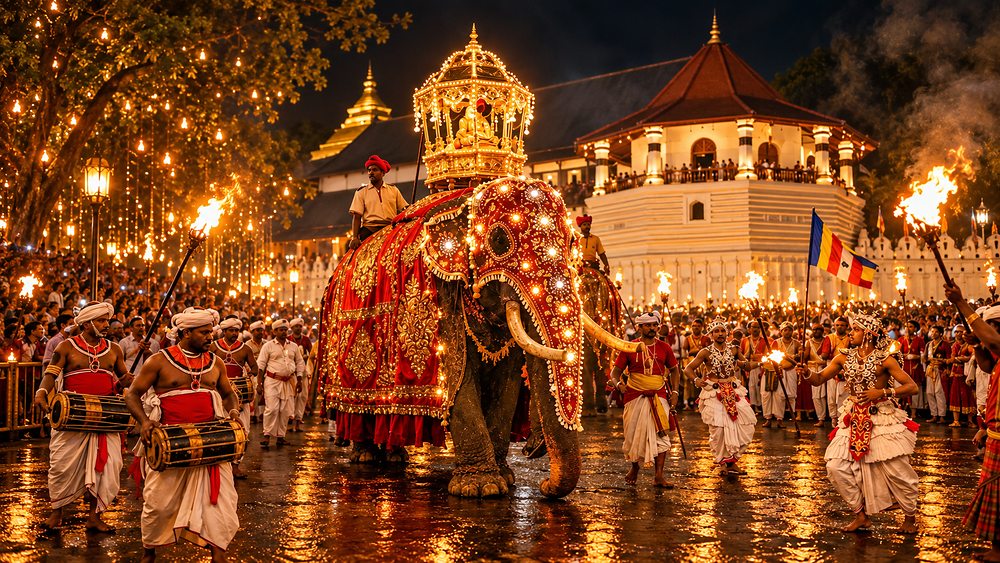
Whip crackers first, clearing the route with a sound like gunfire. Then flag bearers, then the elephants — the tusker carrying the casket walks on a white cloth laid down so its feet never touch the road, and it is lit up and caparisoned in a way that is genuinely startling the first time.
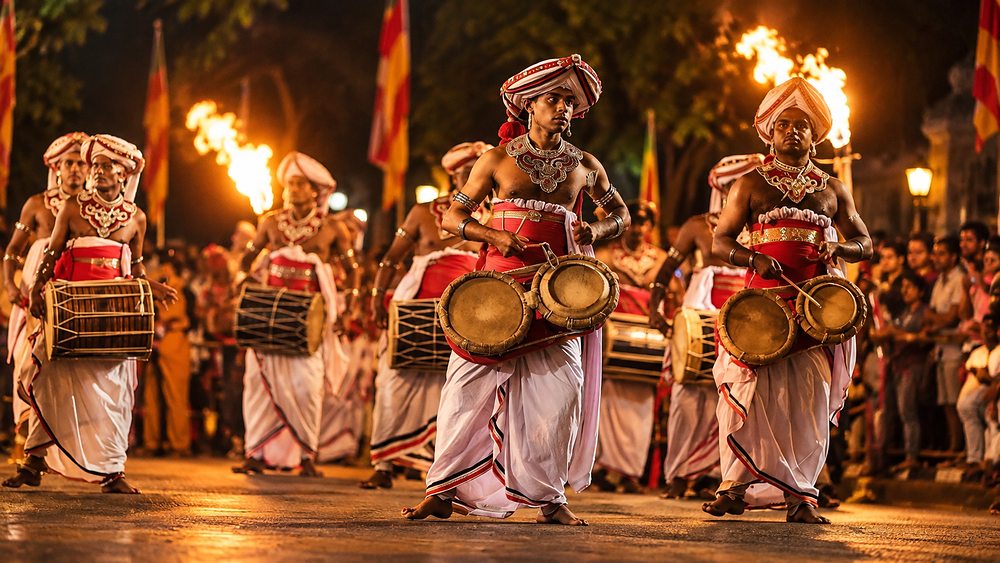
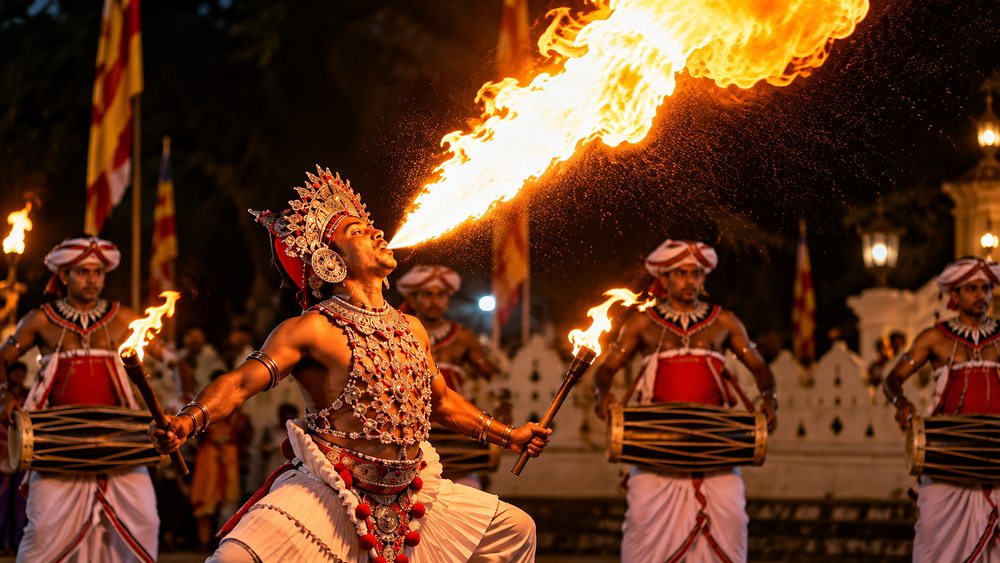
Between them: Kandyan dancers in silver, drummers, fire dancers spinning pots of flame, stilt walkers, more elephants. It goes on far longer than you expect. On the great final nights it can take three hours to pass a single point.
The drumming is the thing that stays with people. It is not background; it arrives physically, and in a narrow street between old buildings it is overwhelming in the proper sense of the word.
Seeing it without paying for a bad seat
Businesses along the route sell balcony and street-level seats, and prices climb steeply toward the final nights. Some are worth it. Many are a plastic chair behind three rows of other plastic chairs.
If you buy a seat, ask exactly where it is and whether the view is over people's heads or through them. Ask what time you need to be there — usually hours before, because roads close. And be clear whether it includes anything at all beyond the chair.
The alternative is to go on an earlier night rather than the last, find a spot on the street two or three hours ahead, and sit on the ground with everyone else. It is less comfortable, considerably cheaper, and a better experience in almost every way that matters.
The earlier nights are smaller, and much easier to actually see.
Practical things
Go to the toilet first; you will not be moving for hours. Bring water and something to sit on. Wear something you can be in for a long evening, cover your shoulders and knees given what this is, and take the shoes off if you go into the temple precinct.
It runs late — the biggest nights start after dark and finish well after midnight. Getting back to a hotel afterwards is a scrum, so stay within walking distance of the route if you possibly can.
Photography is difficult: it is dark, everything moves, and flash is both useless at that distance and rude. Watch it instead. The footage everyone takes is uniformly disappointing and the memory is not.
A word about the elephants
The use of elephants in the Perahera is contested and it would be dishonest to write this without saying so. There have been incidents, there is ongoing criticism from welfare organisations about how the animals are kept and transported, and there has been reform in response, including limits and veterinary oversight.
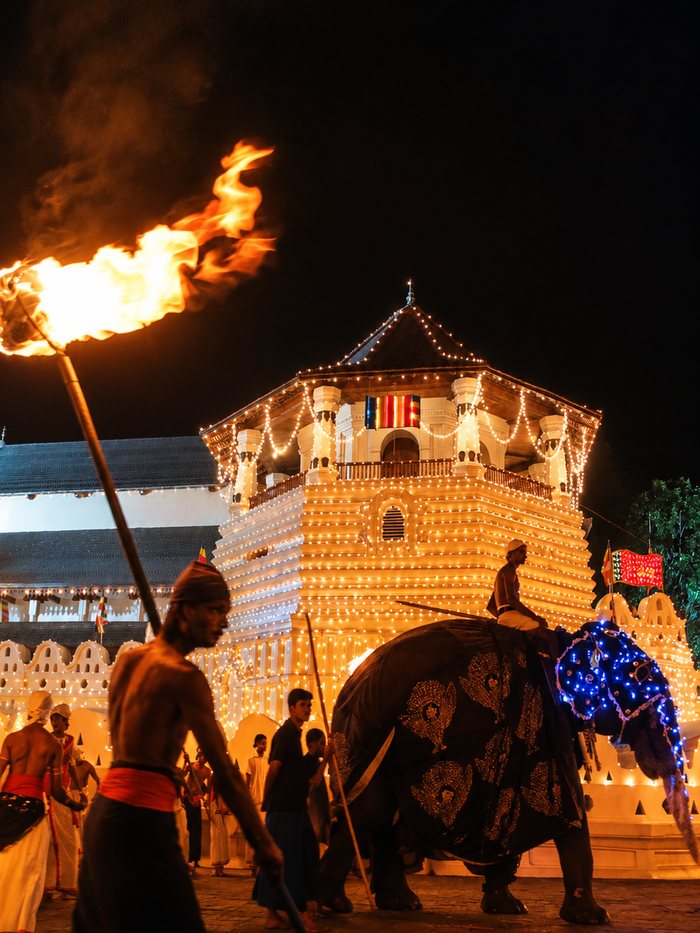
It is a religious procession that predates tourism by centuries and is not staged for visitors — which is a real distinction, though not a complete answer. If it troubles you, that is a reasonable position and worth holding rather than setting aside because the spectacle is remarkable. It is remarkable, and both things are true.
If your dates do not line up
Smaller peraheras happen at temples across the country through the year, and the Nallur festival in Jaffna in July and August is a different tradition doing something comparably extraordinary with chariots rather than elephants. Kandy is the famous one. It is not the only one.
Follow
Plan around it

Leave a comment